
Removing Coatings Near Live Plant: How Induction Enables Simultaneous Operations
The Challenge of Coating Removal in Operating Facilities
For asset owners and maintenance contractors working on refineries, gas terminals, offshore platforms, and marine vessels[a], coating removal rarely happens in isolation. Pipelines still carry product. Adjacent vessels remain pressurised. Deck[b] operations continue overhead. Shutting down an entire facility to complete a coating removal campaign is frequently commercially unviable, and in many cases, operationally impossible.
This is the reality of Simultaneous Operations (SIMOPS): coating removal and surface preparation activities must be executed while surrounding plant remains live, staffed, and functioning. The methods used to strip[c] old coatings, remove corrosion, or eliminate hazardous linings must therefore meet a demanding set of criteria—low ignition[d] risk, minimal disruption to adjacent systems, tight control over waste and airborne contaminants, and compatibility with[e] strict permit-to-work regimes.
Conventional coating removal techniques struggle to meet these requirements simultaneously. Abrasive blasting generates dust clouds and flying media[f] that can travel well beyond the work envelope. Ultra-high-pressure water introduces its own containment and runoff challenges[g]. Chemical stripping requires careful handling of volatile or corrosive agents near sensitive equipment. Each of these methods can force costly isolation zones, extended permits, or complete shutdowns—undermining the very SIMOPS strategy the operation depends on.
Induction Coating Removal (ICR) offers a fundamentally different approach, one that is increasingly the preferred method for operators needing to prepare surfaces without interrupting the systems around them.
Why Traditional Methods Struggle Near Live Plant
Before examining how induction solves the SIMOPS problem, it's worth understanding why conventional methods create such friction in live environments.
Abrasive blasting relies on high-velocity media impact to remove coatings. This generates significant dust and particulate, especially when dealing with legacy coatings such as lead-based paints or asbestos-containing materials[h]. Near live plant, this particulate can contaminate sensitive equipment, obscure visibility for surrounding crews, and create respiratory hazards for personnel working nearby—not just those performing the blasting. Containment structures help, but they add time, cost, and complexity, and rarely eliminate risk entirely.
Ultra-high-pressure water (UHPW) avoids some of the dust issues but introduces large volumes of contaminated wastewater that must be captured, filtered, and disposed of. Near live electrical systems, instrumentation, or process piping, water ingress is a serious concern that often necessitates additional isolation and protective measures.
Chemical stripping methods bring their own volatility—both literally and procedurally. Fumes, flammability, and material compatibility issues mean chemical strippers frequently trigger stricter permit conditions, ventilation requirements, and exclusion zones, all of which slow down work near operating assets.
For a detailed breakdown of how these methods compare on performance, safety, and waste generation, see our dedicated comparison: RPR vs Abrasive Blasting: Which Coating Removal Method Should You Use?
How Induction Coating Removal Changes the Equation[i]
ICR uses electromagnetic induction to disbond coatings from ferromagnetic substrates—without abrasive media, chemical agents, or high-pressure water. An induction generator produces high-frequency alternating current (up to approximately 50 kHz), which passes through a transformer and into an inductor head. This induces eddy currents within the steel substrate itself, but only to a controlled depth of less than 0.5mm[j]. The result is rapid, localized heating precisely at the coating-to-substrate interface.
As the temperature at the bond line rises, the coating loses adhesion and lifts away in large, largely intact sections—rather than being ground down into fine, hazardous dust or dissolved into contaminated liquid waste.
Because the ICR system's core components—generator, transformer, inductor head, integrated cooling circuit, and control electronics—are contained within a compact, portable footprint, the inductor head itself can operate up to approximately 90 meters from the source unit, depending on configuration. This distance is a critical enabler for SIMOPS work: operators can position the heavier equipment in a safe, accessible staging area while the inductor head reaches into constrained or sensitive zones near live systems.
Several characteristics of this process make it particularly well suited to environments where surrounding plant must stay operational:
- No abrasive media or blast debris. There is no particulate cloud to contain, monitor, or clean up, significantly reducing the risk of contaminating adjacent equipment or instrumentation.
- No secondary chemical waste. Coatings are removed as bulk material, not dissolved or aerosolized, simplifying waste handling and reducing the hazard classification of removed material.
- Minimal dust generation. This directly reduces worker exposure to hazardous particulate, including legacy coatings such as lead-based paints, asbestos-containing materials, and rubber linings.
- Virtually silent operation. Compared to blasting or heavy mechanical grinding, induction equipment operates quietly, reducing disruption to personnel working in close proximity.
- Lower energy demand. ICR systems typically run on standard 3-phase power supply, without the need for extensive compressed air infrastructure or high-volume water systems.
Together, these factors mean induction-based coating removal can often proceed with a smaller exclusion zone, a simpler permit structure, and a reduced risk profile—conditions that make true simultaneous operations achievable rather than theoretical.
Reduced Waste, Reduced Risk, Reduced Downtime[k]
One of the most significant advantages of ICR in live-plant scenarios is how it reshapes the waste and risk equation. With abrasive or chemical methods, spent media and coating residue must be managed as contaminated material in its entirety—often at significant hazard classification and disposal cost. This is especially burdensome when dealing with hazardous coatings, where every kilogram of waste carries compliance overhead.
Because ICR disbonds coatings in large, intact sections rather than breaking them into fine particulate, the volume of hazardous waste requiring specialized handling is dramatically reduced. This has a direct, practical benefit for SIMOPS: less material to contain, transport, and dispose of means fewer logistics movements through or near operational areas, shorter permit durations, and a lower likelihood of incidents requiring work stoppage.
From a compliance standpoint, reduced dust and particulate generation also simplifies health and safety management on site. Personnel working nearby—whether on adjacent equipment, walkways, or control stations—face substantially lower exposure risk, which in turn reduces the administrative burden of monitoring, PPE requirements, and exclusion zone enforcement.
This combination of reduced waste and reduced exposure is precisely why induction has become the preferred technology for organizations such as Shell, BP, and the US Navy when coating removal must happen alongside continued operations. Independent verification of these outcomes is available across a range of completed projects in our case studies, spanning storage tank rehabilitation, offshore platforms, live gas pipelines, and marine vessel maintenance—many of which involved coating removal executed in close proximity to operating systems.
Practical Considerations for Planning SIMOPS Coating Removal
While ICR significantly de-risks coating removal near live plant, successful execution still depends on careful planning. A few practical considerations for project teams:
Substrate compatibility. ICR is effective on ferromagnetic substrates—predominantly carbon steel—which covers the vast majority of storage tanks, pipelines, ship hulls, and structural steel found across oil and gas, marine, and infrastructure sectors. Confirming substrate type early in the planning phase ensures the technology aligns with project requirements.
Coating characteristics. Each bonded coating has a characteristic disbonding temperature. Understanding the coating system in place—whether it's a legacy lead-based paint, an epoxy lining, rubber coating, or fireproofing material—allows the induction parameters to be tuned for efficient, controlled removal.
Access and reach. With inductor heads operable up to approximately 90 meters from the source unit, project planners can position source equipment away from congested or restricted areas while still reaching the required work faces. This is particularly valuable on platforms, vessels, and bridges where access is inherently constrained.
Integration with final surface prep. Where specifications call for a specific cleanliness standard prior to recoating, ICR functions as a powerful enabler rather than a standalone endpoint. By rapidly clearing bulk coating from the substrate, it substantially reduces the time and media required for final abrasive blasting or cleaning—shrinking the overall footprint of disruptive activity near live systems.
Permit and isolation planning. Because ICR generates minimal dust and no chemical byproducts, permit-to-work discussions can often focus on electrical safety and localized heat management rather than extensive containment and ventilation requirements—streamlining approval processes for work near operating assets.
Where This Approach Delivers the Most Value
Induction coating removal's compatibility with live-plant conditions makes it especially valuable across several sectors where shutdown is costly or operationally impractical:
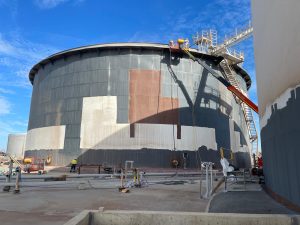
- Storage tanks and pipelines, where product continues flowing through adjacent sections while corroded or failing coatings are addressed on out-of-service segments.
- Offshore platforms, where deck space, personnel density, and weather exposure make containment of abrasive media or chemical agents especially difficult.
- Marine vessels,[l] where coating removal often needs to proceed alongside crew operations, cargo handling, or other maintenance activities in confined spaces.
- Bridges and civil infrastructure, where traffic, public access, or environmental sensitivity (such as proximity to waterways) demand minimal particulate and waste generation.
- Hazardous coatings removal, where reducing worker exposure and secondary waste volume is a regulatory as well as operational priority.
Each of these environments shares a common thread: the surrounding system cannot simply stop while surface preparation takes place. Induction technology is engineered precisely for this reality.
A Technology Built for Operational Continuity
Simultaneous operations will remain a defining constraint for maintenance and refurbishment work across oil and gas, marine, mining, and civil infrastructure sectors. The pressure to keep systems running while addressing aging coatings, corrosion, and hazardous linings is not going away—if anything, it is intensifying as assets age and regulatory scrutiny increases.
Induction Coating Removal directly addresses this pressure. By eliminating[m] abrasive media, minimizing dust and chemical waste, and enabling equipment to be positioned well away from sensitive work zones, ICR allows coating removal to proceed as a controlled, contained activity rather than a disruptive event requiring broad isolation.
For teams planning maintenance or refurbishment work where live plant, restricted access, or hazardous coatings are part of the equation, understanding how induction technology performs under these conditions is an essential part of the planning process. Explore our full range of industry case studies to see how this approach has been applied across storage tanks, offshore platforms, pipelines, and marine vessels—or visit RPR Technologies to discuss how induction coating removal can be integrated into your next SIMOPS-critical project.
[a]operating resource terminals, marine infrastructure facilities, mine sites.
remove marine vessels
[b]remove deck
[c]remove old coatings
[d]emissions, dust
[e]noise
[f]noise and high pressures
[g]and exceptionally high pressures and associated danger
[h]remove
[i]this section is quite repetitive across the blogs and is better trimmed . i think we need one blog that has all the setail then subsequent blogs have a terse section on this with a link pointing to the full description location?
[j]0.3mm
[k]faster turnaround times. the message is you get your asset back, online faster.
[l]marine infrastructure, take information from our other sections. i dont want to highlight crew/vessels etc.
[m]significantly reducing