
Industrial asset owners facing thick, multi-layer, or hazardous coating systems are under increasing pressure to find removal methods that balance speed, safety, and environmental compliance. Two technologies frequently discussed in this context are pulse laser ablation and Induction Coating Removal (ICR). While both are positioned as “cleaner” alternatives to abrasive blasting, sometimes known as sandblasting, they operate on fundamentally different principles and are suited to very different applications.
This article breaks down how each technology works, where it performs best, and why induction-based disbonding remains the preferred solution for heavy, bulk, and hazardous coating removal across marine, offshore, oil and gas, mining, and infrastructure sectors. It also covers where laser ablation is the better tool, because the right answer depends on the coating, the substrate and the scale of the job.
The Short Answer
For thick, multi-layer or hazardous coatings on large steel structures, ICR is usually the faster and cleaner choice, because it disbonds the coating system at the bond line instead of vaporising it one thin layer at a time. Pulse laser ablation is better suited to thin coatings, small or precise areas and non-ferromagnetic substrates. On most heavy industrial projects, the best results come from using ICR for bulk removal, with abrasive blasting completing the surface preparation and providing the anchor profile.
How Pulse Laser Ablation Works
Pulse laser ablation removes coatings by directing high-energy laser pulses at the coated surface. The laser energy is absorbed by the coating material, causing it to vaporise or fragment in thin layers. The beam is typically moved by computer-controlled scanning optics, allowing precise, selective removal of coating from a surface without significant substrate contact.
Laser ablation is well-regarded for its precision. It can be used to strip very thin coatings, surface contaminants, or localised areas with minimal footprint. It uses no blast media and no water, so the waste stream is limited to the ablated coating itself, captured as fine dust and fume by an extraction system. Laser ablation also works on non-ferromagnetic substrates such as aluminium, which induction cannot treat. However, laser systems remove material in micron-level layers, which has direct implications for thick coating systems, a limitation discussed further below.
Field results reflect both sides. In a 2024 pilot on a Connecticut Department of Transportation bridge, a 1,000-watt laser removed coating from 36 locations on steel H-beams ahead of welding, producing around 18 kg (40 lb) of dry powder compared with an estimated 4 to 5.4 tonnes of spent blast media. The contractor also described the process as slow, because the laser “can only take out certain amounts of paint at a time” (ENR).
How Induction Coating Removal Works
Induction Coating Removal takes a fundamentally different approach. Rather than ablating the coating surface layer by layer, ICR targets the bond line between the coating and the ferromagnetic substrate beneath it. Because the process works by inducing current in the steel itself, ICR requires a ferromagnetic substrate, such as carbon or structural steel.
The ICR system applies alternating current at high frequencies, up to approximately 50 kHz, through an induction generator, transformer, and inductor head (coil), typically powered via a 3-phase supply. This induces eddy currents within the steel substrate itself, confined to a controlled depth of less than 0.5mm. The result is rapid, localised heating directly beneath the induction head.
As the substrate temperature rises, the bond line weakens, allowing the coating to disbond from the surface and lift away in large, largely intact sections, rather than being ground, blasted, or vaporised into fine particulate. Because the heating depth is tightly controlled, the underlying steel retains its mechanical properties when the process is correctly applied. For a deeper technical breakdown of how this affects substrate condition, see does Induction Coating Removal damage the steel? Heat input and substrate integrity.
A typical ICR configuration includes:
- Induction Generator: produces the high-frequency current
- Transformer: conditions power delivery from the generator to the inductor head
- Inductor Head (Coil): focuses the electromagnetic field into the substrate
- Integrated Cooling Circuit: ensures operational stability and equipment protection
- Internal Logic, Software, and Controls: regulate heating intensity as the operator traverses the surface
These systems are portable, with the induction head operable up to roughly 90 metres from the source unit depending on configuration, making ICR practical for field deployment on bridges, ships, tanks, pipelines, and offshore platforms.
Coating Thickness: The Core Differentiator
The single most important factor when comparing these two technologies for thick industrial coatings is how each method physically interacts with coating thickness.
Pulse laser ablation removes material incrementally, layer by layer, through vaporisation. On thin coatings, light rust or lightly contaminated surfaces, this is efficient. But as coating thickness increases, particularly with multi-layer marine paint systems, fireproofing, rubber linings, or legacy lead-based systems applied decades ago, ablation throughput drops substantially. Removing several millimetres of coating via sequential micron-layer vaporisation is time- and energy-intensive, and heat can build up in the coating itself during repeated passes.
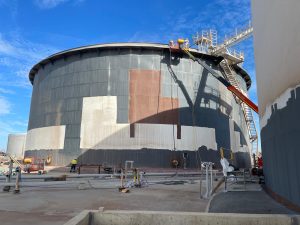
Induction Coating Removal is far less sensitive to coating thickness because it doesn’t attack the coating surface at all. It attacks the bond line. Whether the coating is 300 microns or several millimetres thick, the induction head heats the substrate interface, and the coating system disbonds and lifts away in sections. This makes ICR disproportionately more efficient as coating thickness and bulk volume increase, which is precisely the scenario common in storage tank rehabilitation, ship hulls, and offshore structural steel.
RPR systems are used on coatings up to 25 mm thick. Very thick, elastic or reinforced systems, such as the 20 mm mesh-reinforced fireproofing removed on the Troll A platform, are usually scored or pre-cut into sections before heating so each piece releases cleanly. Even then, the full thickness comes off in one step rather than one thin layer at a time. On a live gas pipeline in Thailand, RPR removed 8 to 12 mm of coal tar enamel at 12 to 14 m² per hour per unit.
Hazardous Coatings and Secondary Waste
Many industrial assets, particularly older infrastructure, ships and tanks, carry coatings containing lead, asbestos, or other regulated hazardous compounds. The removal methodology chosen directly affects worker exposure, waste volume, and compliance burden.
Pulse laser ablation vaporises coating material, which, depending on the coating chemistry and fume extraction setup, can generate hazardous airborne byproducts that require careful capture and filtration. The fine particulate and fume generated must still be managed as hazardous waste. Well-engineered laser systems can control this. A 2019 Virginia Transportation Research Council study found that the engineering controls on the laser system it tested kept operator exposure to hazardous air pollutants well below the US permissible exposure limit while removing lead-based coatings from bridge steel, although the waste was still classed as hazardous (VTRC).
ICR takes a different path. Because the coating disbonds in large, largely intact sections rather than being pulverised or vaporised, airborne particulate is minimised at the source. Conventional abrasive, ultra-high-pressure water, or chemical stripping methods generate large volumes of secondary hazardous waste, including spent media, contaminated water and coating residue, all of which must be managed as hazardous material in its entirety. ICR substantially reduces this hazard load, lowering disposal costs and simplifying regulatory compliance. Because ICR keeps dust down, other teams can also keep working simultaneously in adjacent areas.
This makes ICR particularly well-suited to lead paint removal on bridges, asbestos-containing coatings on legacy marine vessels, and rubber lining removal in tanks. These are scenarios where minimising airborne hazard and secondary waste is a regulatory and operational priority.
For lead-based paints and asbestos-containing materials, the gap between the two methods is at its widest. On Japan’s Kanmon Bridge, where abrasive blasting and UHP water jetting had been banned, three RPR units removed 20,000 m² of coating containing lead and PCBs at 40 to 50 m² per day per unit. In Thailand, coal tar enamel applied over asbestos mesh came off the live gas pipeline as solid flakes rather than airborne particles.
Production Rate and Project Economics
For large-scale industrial projects, such as a storage tank interior, a ship’s hull or a bridge superstructure, production rate (area cleared per hour) is often the determining economic factor.
Pulse laser systems, while precise, are generally better matched to smaller, high-value, or selective-removal applications where precision outweighs throughput. Scaling laser ablation across thousands of square metres of thick, heavily coated structural steel introduces significant time and cost considerations. In the Connecticut pilot, laser removal was described as a little more expensive per square foot than traditional methods on major jobs, but very competitive on small areas.
ICR, by contrast, is designed for bulk removal at scale. Because the coating lifts in large sections rather than being removed incrementally, production rates on thick coatings are substantially higher. Recorded RPR results include up to 22 m² per hour on the deck of the Spanish Navy frigate Cantabria and 12 to 14 m² per hour per unit on 8 to 12 mm of coal tar enamel in Thailand.
This is also why ICR is frequently deployed as a first-pass bulk removal step, with final surface preparation (light blasting or sweep blasting) completing the job to the required cleanliness standard and anchor profile before recoating. This combined approach is the most common application of ICR. ICR does the heavy lifting, removing heavy coatings in bulk, while abrasive blasting cleans up the remaining residue and provides a profile to the steel. In that role, ICR is a force multiplier, making conventional methods such as abrasive blasting many times more effective.
Where specifications still call for conventional cleanliness standards, ICR serves as a highly effective enabler, rapidly removing bulk coatings and minimising the effort required for final blasting or cleaning in preparation for recoating. On the Thailand pipeline, a sweep blast to Sa 2.5 followed induction removal. For a detailed comparison of ICR against traditional abrasive blasting across cost, safety, and output metrics, see RPR vs abrasive blasting: which coating removal method should you use.
Operational Flexibility and Live Environments
Industrial sites rarely offer the luxury of shutting down entire operations for maintenance. Pulse laser systems do not need the full containment used for abrasive blasting, but industrial cleaning lasers are typically Class 4 laser products. That means a controlled laser area, barriers or screening to manage beam reflections, eye protection for anyone inside the zone and fume extraction at the head. In busy plant, those controls can still mean isolating the work area.
ICR systems, by comparison, produce no open flame, minimal dust, and significantly reduced noise relative to abrasive blasting. This profile allows coating removal to proceed with reduced exclusion zones in many settings, supporting work near occupied or live-operating plant and allowing other teams to keep working in adjacent areas. The Thailand gas pipeline stayed live and pressurised throughout the works, and on the frigate Cantabria the silent, vibration-free process protected the ship’s onboard sensors. For more on how this capability translates into real-world scheduling and safety advantages, see removing coatings near live plant: how induction enables simultaneous operations.
Substrate Considerations
A common question for any thermal or energetic removal process is substrate impact. Pulse laser ablation, properly calibrated, is generally low-impact on the substrate surface, though repeated passes on thick coatings can introduce localised heat accumulation. The VTRC study found no detrimental effect on the mechanical properties of the ASTM A36 structural steel it tested.
ICR’s heating effect is engineered to be shallow and controlled. Eddy current penetration is limited to less than 0.5mm into the ferromagnetic substrate. Combined with software-regulated output that lets the operator match heat input to the coating’s disbonding temperature, this keeps thermal influence on the steel itself within tightly managed bounds, preserving substrate mechanical integrity even on structurally critical components such as pressure vessels, hulls, and pipelines.
Neither method creates a fresh anchor profile on its own. Laser ablation generally cleans down to the existing surface, and ICR removes the coating without abrading the steel. Where the new coating system specifies an anchor profile, abrasive blasting is still the step that provides it.
Choosing the Right Method for Thick Industrial Coatings
| Factor | Pulse Laser Ablation | Induction Coating Removal |
|---|---|---|
| Best suited to | Thin coatings, precision/selective removal, small areas | Thick, bulk, multi-layer, and hazardous coatings |
| Removal mechanism | Layer-by-layer vaporisation | Bond-line disbonding, bulk lift-off |
| Substrate | Metals, including non-ferromagnetic materials such as aluminium | Ferromagnetic substrates only, such as carbon and structural steel |
| Secondary waste | Fume/particulate requiring capture | Minimal particulate, reduced hazardous waste volume |
| Throughput on thick coatings | Decreases with thickness | Far less sensitive to thickness; very thick or reinforced coatings may need pre-cutting |
| Hazardous coating suitability | Requires robust fume extraction | Well suited to lead-based paints, asbestos-containing materials and rubber linings |
| Site flexibility | Controlled laser area, eye protection and fume extraction | Reduced noise/dust supports live-plant operations and adjacent work |
| Substrate impact | Low, with risk of heat buildup on repeat passes | Controlled, shallow, monitored heat input |
| Anchor profile | Generally not created; abrasive blasting needed if specified | Not created; abrasive blasting provides it, usually as a lighter final pass |
For organisations managing thick, aged, or hazardous coating systems on large ferromagnetic structures, such as storage tanks, ship hulls, offshore platforms, pipelines and bridges, Induction Coating Removal offers a combination of throughput, waste reduction, and operational flexibility that pulse laser ablation is not engineered to match at scale. Laser ablation retains a role where precision, selectivity, non-ferromagnetic substrates and thin-film removal are the priority, but for bulk industrial coating removal, induction technology is purpose-built for the task.
On many projects the methods can sit side by side: ICR for bulk removal across large steel areas, abrasive blasting for the final clean and anchor profile, and laser ablation for small, sensitive or non-ferromagnetic areas. In that mix, ICR is the force multiplier, making the conventional steps that follow it many times more effective.
RPR Technologies has deployed patented induction disbonding systems across marine, offshore, oil and gas, mining, and infrastructure projects worldwide, working with operators including Shell, BP, and the US Navy. To discuss which coating removal approach is right for your asset, contact RPR Technologies or explore our case studies for real-world project outcomes.
Frequently Asked Questions
Is laser ablation better than induction coating removal?
It depends on the job. Laser ablation is better for thin coatings, precise work and non-ferromagnetic substrates. ICR is better for thick, multi-layer and hazardous coatings on large steel structures, where it removes the coating system at the bond line instead of one thin layer at a time.
Can laser ablation remove thick coatings?
It can, but slowly. Each pass removes only a thin layer, so throughput drops as thickness increases, and heat can build up in the coating during repeated passes. For coatings measured in millimetres, ICR is usually far faster.
Does induction coating removal replace abrasive blasting?
In some instances, absolutely, such as where bulk coating removal is all the work requires. In most instances, ICR is a force multiplier, making abrasive blasting many times more effective. ICR removes the heavy coating in bulk, and abrasive blasting cleans up the residue and provides the anchor profile.
Which method is better for lead paint and asbestos-containing coatings?
Both can be used with the right controls. Laser ablation turns the coating into fine particulate and fume that must be captured at the head. ICR disbonds lead-based paints and asbestos-containing materials in large sections with their integrity largely intact, which keeps dust down at the source, reduces worker exposure and lets other teams keep working in adjacent areas.
What substrates does each method work on?
ICR requires a ferromagnetic substrate, such as carbon or structural steel, because it relies on inducing eddy currents within the steel. Laser ablation can also be used on non-ferromagnetic metals such as aluminium.