
Does Induction Coating Removal Damage the Steel? Heat Input and Substrate Integrity
For asset owners and contractors evaluating new coating removal technologies, one question consistently rises to the top of the due diligence list: what does this process do to the steel underneath? Substrate integrity is not a secondary consideration in industrial surface preparation — it is the entire point of the exercise. Whether the asset is a storage tank, a pipeline, a bridge girder, or a ship's hull, the steel itself is the asset. Any coating removal method that compromises that steel, even marginally, creates downstream risk that can outweigh whatever time or cost savings it delivers.
Induction Coating Removal (ICR) is often introduced to specification engineers and asset integrity teams as a faster, cleaner alternative to abrasive blasting. But because ICR works by applying heat to the substrate, it invites a reasonable and important technical question: does the heat input associated with induction disbonding affect the mechanical properties, metallurgy, or long-term integrity of the steel? This article answers that question directly, using the underlying physics of the ICR process to explain why, when correctly applied, induction-based coating removal does not compromise substrate integrity.
How Induction Coating Removal Actually Works
Before addressing heat-related concerns, it is worth understanding exactly how ICR interacts with a steel substrate at a physical level, because the mechanism is very different from how most people initially assume it works.
An ICR system consists of an induction generator, a transformer, an inductor head (coil), an integrated cooling circuit, and onboard control logic. The generator produces alternating current at high frequencies — typically up to around 50 kHz — which is delivered through the transformer to the inductor head. As the coil is passed over a ferromagnetic surface, it generates an electromagnetic field that induces eddy currents directly within the steel.
This is the critical detail: the heating effect is not applied to the surface from an external heat source, such as a flame or hot air jet. It is generated internally, within the steel itself, through electromagnetic induction. Those eddy currents are confined to a very shallow depth — less than 0.5mm below the surface — where they generate rapid, localized heating. This heat rises quickly enough at the coating-to-substrate interface to weaken the bond line, allowing the coating to disbond and lift away in large, largely intact sections.
Because the heating zone is so shallow and so tightly controlled, the vast majority of the steel's cross-section — and therefore its structural mass — remains at or near ambient temperature throughout the process. This is the foundation of why ICR is considered a substrate-safe technology, and it's a fundamentally different heat profile than open-flame or torch-based paint removal methods, which apply broad, less controlled heat across a much larger volume of steel.
Understanding Heat Input: Depth, Duration, and Distribution
Heat input is generally discussed in industrial contexts in terms of three variables: how deep the heat penetrates, how long the material is exposed to elevated temperature, and how the heat is distributed across the part. ICR is engineered to keep all three of these variables tightly constrained.
Depth of penetration is governed by the frequency of the alternating current. Higher frequencies produce a shallower "skin effect," concentrating eddy currents closer to the surface. ICR systems operating at frequencies up to approximately 50 kHz are tuned specifically to keep the induced heating zone within that sub-0.5mm layer, well short of any depth that would influence the bulk mechanical properties of standard structural or plate steel.
Duration of exposure is a function of traverse speed and operator control. Because the inductor head is moved continuously across the surface — rather than held stationary — any single point on the steel is exposed to peak induction heating for a brief window before the head moves on and the cooling circuit and ambient conditions allow the surface to begin returning toward baseline temperature. Operators adjust heating intensity as the head traverses the surface, allowing the process to be tuned to the specific coating and substrate thickness rather than applying a fixed, uncontrolled heat dose.
Distribution of heat is inherently localized because the electromagnetic field is focused directly beneath the inductor head. Unlike open-flame heating, which radiates outward and heats a broader area indiscriminately, induction heating is confined to the footprint of the coil. This means adjacent areas of steel, and the coating still bonded elsewhere on the structure, are not subjected to incidental thermal loading during the pass.
Together, these controls mean that ICR delivers heat precisely where it is needed — at the bond line — without driving significant thermal energy into the structural mass of the component.
Why This Heat Profile Does Not Compromise Substrate Integrity
Concerns about heat-affected zones (HAZ) in steel typically stem from welding and other high-temperature fabrication processes, where sustained heat at depth can alter grain structure, reduce toughness, or introduce residual stress. ICR's heating profile is categorically different from these processes for several reasons.
First, the shallow depth of induced current means the thermal event is confined to a thin surface layer, not the structural core of the plate or component. For typical industrial substrates — tank shells, pipeline walls, structural steel — this depth is a small fraction of overall wall or plate thickness, so any localized temperature rise does not meaningfully affect the load-bearing cross-section.
Second, the transient nature of the heating — rapid rise as the coil passes, followed by equally rapid dissipation — limits the time available for any metallurgical transformation to occur. Sustained high temperature over extended periods is what drives changes in grain structure; brief, localized, and quickly dissipating heat does not provide the same thermal "dwell time."
Third, the process is designed around coating disbonding temperatures, not steel transformation temperatures. Bonded coatings — paints, linings, fireproofing, rubber compounds — each have a characteristic disbonding temperature that is far below the temperatures required to alter the microstructure of structural steel. ICR systems are tuned to reach the former, not the latter, which is precisely why the technology can disbond coatings while leaving substrate properties intact.
Finally, the integrated cooling circuit built into ICR equipment is not just an equipment-protection feature — it also contributes to the tightly controlled thermal cycle experienced by the substrate, reinforcing the localized and transient nature of the heat input.
Comparing Substrate Impact Against Other Removal Methods
It is useful to place ICR's substrate impact in context against the other primary coating removal methods used across industrial sectors.
Abrasive blasting removes coatings through mechanical impact, which can profile, roughen, or in cases of poor process control, over-blast and erode the substrate — particularly on thinner-gauge steel or where corrosion has already reduced wall thickness. Blasting also generates significant secondary waste in the form of spent media and coating debris, all of which must be managed as contaminated material. A detailed breakdown of how these two approaches compare is available in our article on RPR vs. abrasive blasting, which covers waste handling, safety profile, and productivity differences in more depth.
Ultra-high-pressure water (UHPW) methods avoid mechanical abrasion but introduce large volumes of contaminated wastewater that require containment and treatment, and do not offer the same bulk-removal efficiency on thick or multi-layer coatings.
Chemical stripping avoids both abrasive and thermal loading on the substrate, but introduces its own handling, ventilation, and disposal complexities, and is generally slower on large-scale industrial applications.
Open-flame or torch-based heat methods, while conceptually similar to ICR in that they use heat to weaken bond lines, apply that heat far less precisely — often heating a broader area to higher temperatures for longer durations, with a corresponding increase in the risk of affecting the substrate and a materially higher fire risk on site.
Against this landscape, ICR's combination of shallow, transient, tightly localized heat input; minimal secondary waste; and no mechanical abrasion positions it as a substrate-conscious method suited to applications where preserving base metal integrity is a priority — including vessels, tanks, and structures that will remain in service for decades.
Real-World Application: Where Substrate Integrity Matters Most
The question of substrate impact is not academic — it drives real specification decisions across sectors where asset lifespan and structural reliability are non-negotiable.
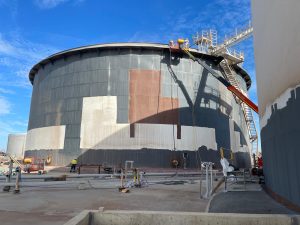
In storage tank rehabilitation, operators need to remove failed internal or external coatings without introducing new defects into tank shells that must hold pressure and resist corrosion for years afterward. In pipeline maintenance, coating removal ahead of recoating or inspection must not thin or weaken pipe walls that are already engineered to tight tolerances. On bridges and marine infrastructure, structural steel is subjected to cyclic loading, and any process that introduces unintended stress concentrations or metallurgical changes carries long-term fatigue implications. In offshore and mining environments, where inspection access is difficult and asset replacement is costly, contractors need confidence that surface preparation work will not create hidden problems that surface later in the asset's life.
RPR Technologies has documented ICR's performance across exactly these types of demanding environments — from tank internals to offshore platform fireproofing removal to bridge structures — where substrate preservation was as critical a requirement as removal speed or waste reduction. Readers can review these outcomes in detail in our case studies, which document real project conditions, coating types, and results across marine, offshore, and infrastructure applications.
Verifying Substrate Condition Post-ICR
For teams that want empirical confirmation rather than theoretical assurance, substrate condition following ICR treatment can be verified using the same inspection methods already standard in industrial coating work: ultrasonic thickness testing to confirm no material loss, surface profile measurement to confirm the substrate has not been mechanically altered, and, where required, metallurgical sampling to confirm no change to hardness or grain structure in the treated zone. Because ICR does not remove or erode base metal — unlike abrasive methods — thickness readings taken before and after treatment consistently demonstrate that wall thickness is preserved.
This verifiability is part of why ICR has been adopted by major industrial operators managing critical infrastructure, where every surface preparation decision is subject to engineering scrutiny and long-term performance accountability.
Conclusion: Precision Heat, Preserved Steel
The short answer to the question posed at the outset is that correctly applied Induction Coating Removal does not damage steel substrates. The process is engineered specifically to exploit the temperature differential between a coating's disbonding point and the much higher temperatures required to affect steel's mechanical or metallurgical properties. By confining eddy current heating to a shallow, sub-surface layer and limiting exposure through controlled traverse speed and operator-adjustable output, ICR delivers heat exactly where it is needed — at the bond line — and nowhere else.
For asset owners and contractors balancing the competing demands of removal speed, hazardous waste reduction, worker safety, and long-term structural integrity, this makes ICR a technically sound choice for surface preparation on ferromagnetic substrates across storage tanks, pipelines, bridges, marine vessels, and offshore facilities alike.
To discuss how induction coating removal can be applied to your specific substrate and coating conditions, visit RPR Technologies to speak with our technical team about your next surface preparation project.