
Heavy industry doesn’t run on a single tool. Surface preparation programs for bridges, storage tanks, offshore platforms, and marine vessels are built from a combination of equipment: blast pots and compressors for abrasive blasting, sometimes known as sandblasting, UHP water jetting units, vacuum recovery systems, containment structures, and increasingly, induction coating removal (ICR) systems. The question facing asset owners and contractors is rarely “which single technology should we use,” but rather “how do these technologies work together to deliver the fastest, safest, and most compliant result.”
This article places ICR within the broader blast and paint equipment landscape, outlining where it adds the most value, how it integrates with conventional methods, and why operators including Shell, BP and the US Navy have used it on large, coated steel assets.
The Short Answer
ICR is not a replacement for the blast and paint kit. It is the piece that removes the bottleneck. ICR does the heavy lifting, disbonding thick, multi-layer and hazardous coatings from steel in bulk, while abrasive blasting cleans up the remaining residue and provides the anchor profile the new coating needs. Used together, ICR acts as a force multiplier, making conventional equipment many times more effective.
The Traditional Blast and Paint Equipment Stack
Most heavy industry coating removal programs are built around a familiar set of equipment categories:
- Abrasive blasting systems: pots, compressors, nozzles, and recovery/vacuum units for dry or wet abrasive blasting, using media such as garnet, steel grit, aluminium oxide, steel shot or other engineered abrasives
- Ultra-high-pressure (UHP) water jetting units: for coating removal without abrasive media, often used where dust control is critical
- Chemical stripping systems: for localised or delicate removal where mechanical methods risk substrate damage
- Containment and ventilation equipment: tenting, negative air units, and dust collection to manage hazardous particulate
- Coating application equipment: spray rigs, airless units, and climate control systems for the repaint phase
Each of these tools performs well within its design envelope, but the removal methods in this list share a common constraint: they remove coating by physically or chemically attacking the coating film itself, generating substantial secondary waste in the process. On large-scale heavy coating removal jobs, such as thick multi-layer systems, rubber linings, fireproofing or hazardous coatings, this becomes the limiting factor for schedule, cost, and compliance.
Where Induction Coating Removal Changes the Equation
Induction Coating Removal introduces a fundamentally different mechanism into the kit. Rather than attacking the coating surface, ICR targets the bond line between the coating and the ferromagnetic substrate beneath it. ICR requires a ferromagnetic substrate, such as carbon or structural steel, because the process works by inducing current in the steel itself.
An ICR system applies alternating current at high frequencies, up to approximately 50 kHz, through an induction generator, transformer, and inductor head. This induces eddy currents within the steel substrate to a controlled depth of less than 0.5mm, generating rapid, localised heating directly beneath the induction head. As the substrate temperature rises, the bond line weakens, and the coating disbonds and lifts away in large, largely intact sections rather than being ground, blasted, or dissolved into fine particulate.
A typical ICR configuration consists of:
- Induction Generator: produces the high-frequency current, typically from a 3-phase power supply
- Transformer: conditions power delivery from the generator to the inductor head
- Inductor Head (Coil): focuses the electromagnetic field into the substrate
- Integrated Cooling Circuit: maintains operational stability and protects equipment
- Internal Logic, Software, and Controls: regulate induction output as the operator traverses the head across the surface
The system is portable, with the induction head operable up to approximately 90 metres from the source unit depending on configuration. That design suits field applications across bridges, shipyards, oil and gas facilities, and large infrastructure maintenance sites where mobility and access constraints rule out heavier fixed equipment.
How ICR Compares with the Rest of the Kit
| Equipment | Best at | Limits on heavy coatings | How it pairs with ICR |
|---|---|---|---|
| Abrasive blasting | Cleanliness to specification and creating the anchor profile | Slow on thick coatings; large volumes of spent media, all contaminated when hazardous coatings are present | Final clean and profile after ICR bulk removal, using far less media |
| UHP water jetting | Removal without abrasive media, with good dust control | Large water volumes to capture and treat; does not create a new anchor profile | Alternative final cleaning step where the specification allows |
| Chemical stripping | Localised or delicate removal | Slow on thick systems; chemical waste and handling requirements | Small or non-ferromagnetic areas that ICR cannot treat |
| Containment and ventilation | Controlling hazardous dust from blasting | Cost and set-up time scale with the dust generated | Smaller scope needed during the low-dust ICR stage |
| ICR | Bulk removal of thick, multi-layer and hazardous coatings from steel | Requires a ferromagnetic substrate; does not create an anchor profile | The bulk removal stage that makes the rest of the kit faster |
ICR as an Enabler, Not a Replacement
A common misconception is that induction coating removal competes directly with abrasive blasting for every job. In practice, ICR functions most effectively as an accelerator within an end-to-end surface preparation regime, rather than a wholesale replacement for every piece of equipment on site. It is best understood as a force multiplier: ICR does the heavy lifting, removing heavy coatings in bulk, while abrasive blasting cleans up the remaining residue and provides a profile to the steel.
On projects with thick, multi-layer, or heavy coating systems, ICR is typically deployed as the bulk removal stage, disbonding the majority of coating thickness quickly and in large sections. This dramatically reduces the volume of material that then needs to be addressed by blasting or final cleaning to reach specified surface cleanliness standards. The result is a shorter overall project timeline, lower abrasive consumption, and less secondary waste to manage, without compromising the final substrate finish required for recoating.
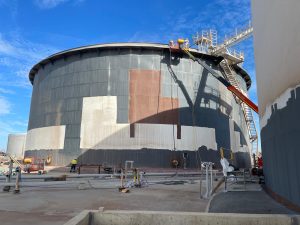
Where specifications still call for conventional cleanliness standards, ICR serves as a highly effective enabler, rapidly removing bulk coatings and minimising the effort required for final blasting or cleaning in preparation for recoating. On a live gas pipeline in Thailand, RPR units removed 8 to 12 mm of coal tar enamel at 12 to 14 m² per hour per unit, and a sweep blast then brought the steel to Sa 2.5. At the RG Tanna Coal Terminal in Australia, induction removal of coal tar epoxy ran at 7 to 8 m² per hour against 1 to 2 m² per hour for the traditional method, and drastically reduced the garnet needed for the follow-up blast.
For a detailed side-by-side comparison of outcomes, cycle times, and waste profiles, see our breakdown of RPR vs abrasive blasting and which coating removal method you should use.
Handling Hazardous and Heavy Coatings
Where the blast and paint equipment stack is under the most pressure is on jobs involving hazardous coatings, such as lead-based paints, asbestos-containing materials, and rubber linings, and on heavy systems such as thick passive fire protection. Conventional abrasive, ultra-high-pressure water, or chemical methods generate large volumes of secondary hazardous waste. Every particle of spent media and coating residue must be collected, tested, and managed as contaminated material in its entirety.
ICR changes this profile substantially. Because coatings are released in large, largely intact sections rather than fine particulate, the hazardous waste stream is reduced at the source. This minimises worker exposure to airborne hazardous particulate, simplifies health and safety management, and avoids the complex handling and disposal procedures associated with abrasive media and chemical strippers. In many jurisdictions, this translates directly into lower compliance costs and stronger alignment with occupational safety and environmental protection standards. Because ICR keeps dust down, other teams can often keep working simultaneously in adjacent areas.
On Japan’s Kanmon Bridge, where abrasive blasting and UHP water jetting had been banned, three RPR units removed 20,000 m² of paint containing lead and PCBs at 40 to 50 m² per day per unit, and the volume and cost of hazardous waste disposal were dramatically reduced compared with any alternative method.
This is one of the main reasons operators turn to ICR for hazardous coating removal across marine, offshore, and infrastructure sectors.
Substrate Integrity and Equipment Selection
Equipment selection in heavy industry surface preparation is never just about removal speed. It is also about what happens to the substrate underneath. Abrasive blasting can introduce distortion risk on thin sections and profile variation when media selection or blasting parameters are not well controlled. Chemical stripping carries its own set of substrate compatibility concerns.
Because ICR heats the substrate to a controlled depth of less than 0.5mm and only to the temperature needed to break the coating bond line, it is engineered to limit thermal effects on the base steel. For contractors and asset owners evaluating heat input risk as part of their equipment selection process, our detailed technical analysis on whether induction coating removal damages the steel through heat input and substrate integrity covers the engineering controls that govern this process.
Equipment choice can also protect what sits on the steel. On the Spanish Navy frigate Cantabria, mechanical milling of the deck coating had caused vibration that damaged onboard sensors. The silent, vibration-free induction process protected the sensors and reached stripping rates of up to 22 m² per hour on wide deck sections.
Operating Near Live Plant and Occupied Facilities
One of the most significant practical advantages ICR brings to a mixed equipment kit is its compatibility with live operations. Abrasive blasting and UHP water jetting typically require extensive containment, exclusion zones, and restrictions on work in adjacent areas due to dust, noise, overspray, and water ingress risks.
Because ICR generates minimal dust, reduced noise, and no liquid waste stream, it is far better suited to coating removal work conducted near live plant, occupied vessels, or operational infrastructure, and other teams can often continue working simultaneously in adjacent areas. The Thailand gas pipeline, for example, stayed live and pressurised throughout its coating removal program. This capability is explored in depth in our article on removing coatings near live plant and how induction enables simultaneous operations, which outlines how operators have used ICR to maintain production schedules while coating removal work proceeds in parallel.
Building an Integrated Surface Preparation Program
For project planners assembling a blast and paint equipment strategy, the practical framework looks like this:
- Assess coating type, thickness, and hazard profile: thick, multi-layer, or hazardous coatings are strong candidates for ICR as the bulk removal stage
- Define substrate constraints: ICR requires a ferromagnetic substrate, so confirm the material first, then evaluate section thickness and geometry against heat input tolerances
- Determine operational constraints: proximity to live plant, occupied facilities, or environmentally sensitive sites favours low-dust, low-noise methods
- Sequence the removal stages: use ICR for bulk disbonding, then apply targeted abrasive blasting or final cleaning to achieve specified surface cleanliness standards and the anchor profile
- Confirm power and access: plan for a 3-phase power supply and a position for the unit within reach of the work, with the head operable up to approximately 90 metres away depending on configuration
- Plan waste management accordingly: factor in the reduced secondary waste volumes ICR delivers when calculating disposal costs and compliance requirements
This staged approach is already standard practice across the sectors RPR Technologies serves, from storage tank rehabilitation and pipeline life extension to bridge maintenance, ship and marine vessel coating removal, offshore platform operations, and mining and resources infrastructure.
Where ICR Fits: A Summary
Induction coating removal is not designed to replace every piece of equipment in the heavy industry surface preparation kit. It is designed to remove the bottleneck: the slow, labour-intensive, high-waste process of stripping bulk and hazardous coatings from large ferromagnetic structures. By disbonding coatings at the bond line rather than attacking the coating surface, ICR delivers faster cycle times, far less abrasive media and secondary waste, reduced dust and noise, and enhanced worker safety, while preserving the substrate integrity required for recoating.
For contractors and asset owners managing coating removal across marine, offshore, mining, oil and gas, and infrastructure assets, the practical answer isn’t abrasive blasting versus induction. It is knowing when each technology adds the most value, and sequencing them accordingly. In most cases, that means ICR doing the heavy lifting and abrasive blasting providing the final clean and anchor profile, with ICR acting as a force multiplier for the whole kit.
To explore how induction coating removal integrates with your current equipment and project specifications, review our case studies or visit the technology overview for a full technical breakdown of RPR Technologies’ patented ICR systems. To talk through your next project, contact RPR Technologies.
Frequently Asked Questions
Is induction coating removal a replacement for abrasive blasting equipment?
In some instances, absolutely, such as where the job only needs bulk coating removal. In most instances, ICR is a force multiplier, making abrasive blasting many times more effective. ICR removes the heavy coating in bulk, and abrasive blasting cleans up the residue and provides the anchor profile.
Is sandblasting equipment still used in heavy industry?
Yes, although “sandblasting” is an older industry term. Modern abrasive blasting uses media such as garnet, steel grit, aluminium oxide, steel shot or other engineered abrasives, and it remains the standard way to achieve specified cleanliness and an anchor profile. ICR shortens the blasting stage by removing the bulk coating first.
What power does an ICR system need?
An ICR system typically runs from a 3-phase power supply. The induction head can operate up to approximately 90 metres from the source unit, depending on configuration, so the unit can stay clear of the work face.
Can ICR be used on lead-based paint and asbestos-containing coatings?
Yes. ICR disbonds lead-based paints and asbestos-containing materials in large sections with their integrity largely intact, which keeps dust down, reduces worker exposure and shrinks the hazardous waste stream. The regulatory controls that apply to hazardous materials still apply.
What substrates does ICR work on?
ICR requires a ferromagnetic substrate, such as carbon or structural steel. It is used on storage tanks, pipelines, bridges, ship hulls and decks, offshore structures and mining equipment.