





How RPR Works

how_it_works.gif

RPR Basic Components

basic_components2.jpg
The basic components needed for RPR surface preparation are:
  • AC power supply

  • The patented RPR system, consisting of
    • the RPR induction generator unit with control panel
    • an intermediate transformer
    • the RPR inductor hand-held unit with induction coil (paint stripping head)
    • system cables with water cooling
  • An electrically conductive work piece = the (steel) surface to be treated

RPR Induction-Based Coatings Removal

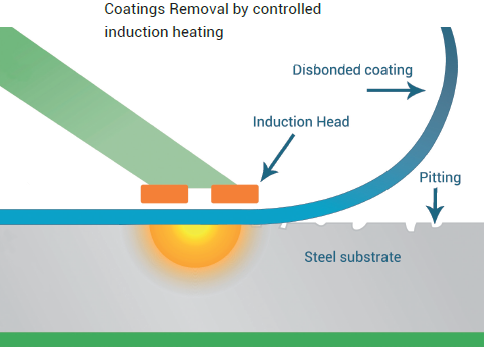
While the system is activated, the power supply sends alternating current through the heating coil, generating an electromagnetic field and inducing eddy currents within the work piece, giving precisely controlled amounts of clean, localized heat without any physical contact between the inductor head and the work piece (no wear and tear). This controlled, localized heating causes instant disbonding of coatings and rust (or mill scale) beneath the inductor head position.

The heating pattern is always the same for a given set-up, ensuring consistency and optimizing the resulting surface treatment quality. When activated, the process starts instantly, inducing heat in the work piece immediately achieving control of the disbonding temperature level within milliseconds.

The RPR induction heating is highly directional: a very small area of the work piece, limited to the position of the inductor stripping head, is induction heated without affecting surrounding areas. Power input is controlled automatically to achieve the temperature range required for slower or faster heating and disbonding.

RPR induces heat (energy) only where and when it is needed. As induction heating by itself does not produce harmful emissions, exhaust gases, smoke, loud noise or waste heat, there is no negative impact on the surrounding environment.

RPR uses only 25% of the energy per surface unit required for conventional methods:
  Power consumption RPR abrasive blasting / water jetting
  kWh per m2 0.75 3.00
  kWh per ft2 0.07 0.28
The energy-efficient RPR process converts over 90% of the energy expended into useful heat. This represents a much higher efficiency rating than is possible with conventional surface preparation methods. The results are reduced costs and time savings. Stand-by heat loss is reduced to a minimum, since the heat is only ‘active’ while the system is actually working, i.e. performing its task.

There is a correlation between the frequency of the electromagnetic field and the heat penetration in the work piece:
RPR can be pre-set by the operator to achieve repeatable optimum performance, depending on the condition of the surface to be treated, the material to be removed and other applicable specifications.

PRP Rust & Paint Removal by Localized Induction Heating

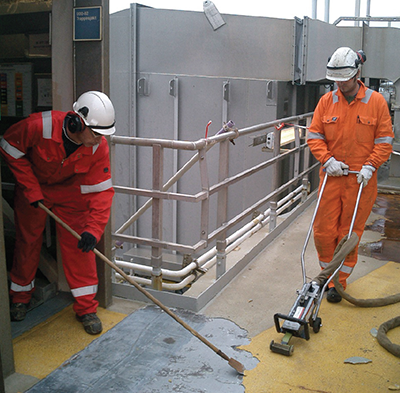
The inductor head generates the electromagnetic field and is moved by the RPR operator over the surface to be treated. At the position of the inductor head, the steel reaches the required, pre-set temperature range within milliseconds. This causes instant disbonding between paint, rust, mill scale, etc.

With the induction heat penetrating only 0.3-0.5 mm into the substrate, paint and rust will be disbonded on the treated side of the object, while any coating on the reverse side will not be damaged or affected at all.

Paint, rust, mill scale etc. come loose and can easily be peeled off or removed otherwise with scraper tools or similar equipment. Oil and grease residues present on the surface will also be removed by RPR induction heating.

A general recommendation is that steel objects to be RPR induction-treated should have a minimum thickness of 5 mm (slightly less than 1/4"). RPR has been tested on steel plates of 3 mm thickness (just under 1/8"). The coatings removal was a success, but RPR recommends that operators themselves run trial tests on all steel less than 5mm before full coatings removal jobs.

The image below shows how the RPR system disbonds coatings:
induction_diagram.gif